
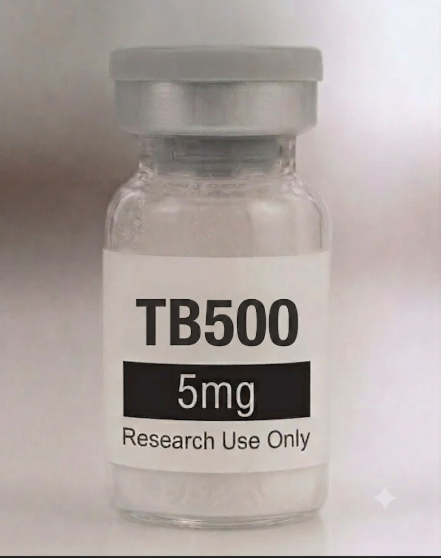
Description
Product Overview: TB-500 (Thymosin Beta-4 Fragment)
TB-500 is a synthetic peptide containing the active region (specifically LKKTETQ) of naturally occurring Thymosin Beta-4 ($\text{T}\beta\text{-4}$). Naturally present in high concentrations in blood platelets, wound fluid, and damaged tissues, Thymosin Beta-4 is a key regulator of actin sequestration and cellular motility. TB-500 is engineered to promote cell migration, stimulate angiogenesis (new blood vessel formation), and accelerate tissue remodeling in cardiovascular, musculoskeletal, and dermal research models.
Primary Research Applications & Reasons for Study
- Actin Cytoskeleton Dynamics: Sequestration of G-actin monomers to regulate intracellular actin polymerization, directly driving cell motility and structural repair.
- Angiogenesis & Microvascular Growth: Stimulating endothelial cell migration and capillary tube formation to re-establish blood supply in ischemic tissue assays.
- Connective Tissue Repair: Accelerating collagen deposition, tenocyte proliferation, and myofiber recovery in acute tendon, ligament, and muscle injury models.
- Anti-Fibrotic & Anti-Inflammatory Signaling: Downregulating pro-inflammatory cytokines ($\text{TNF-}\alpha$, $\text{IL-1}\beta$) to minimize scar tissue formation and adhesion development during tissue healing.
Expected Research Results & Timeline Metrics
- Phase 1 / Days 1–5
Acute Cellular Recruitment: Rapid upregulation of endothelial cell migration, localized actin restructuring, and initial reduction of acute inflammatory markers at injury sites. - Phase 2 / Weeks 2–4
Angiogenesis & Matrix Rebuilding: Statistically significant increases in capillary density, accelerated re-epithelialization in dermal wound models, and enhanced tensile strength in damaged tendons. - Phase 3 / Weeks 4–8
Structural Remodeling: Complete tissue remodeling characterized by aligned collagen fiber matrix formation, suppressed fibrous scarring, and restored functional biomechanics in muscle/joint protocols.
Key Research Benefits
- Low Molecular Weight: Compact structural size allows superior tissue permeability and rapid systemic transport compared to native full-length proteins.
- Systemic Mobility: Circulates effectively throughout experimental fluid systems, enabling targeted migration to sites of cellular distress.
- Multi-Tissue Versatility: Demonstrates high efficacy across diverse tissue types, including cardiac, skeletal muscle, ocular, and dermal cell cultures.
- Regenerative Synergy: Frequently paired with BPC-157 in dual-peptide healing assays to evaluate complementary angiogenesis and tissue repair pathways.
THIS PRODUCT IS INTENDED SOLELY FOR IN VITRO LABORATORY RESEARCH AND EXPERIMENTAL PURPOSES. It is strictly prohibited for human consumption, clinical trials, therapeutic administration, cosmetic use, or veterinary application. This product is not an FDA-approved drug, medical food, or dietary supplement. It is not intended to diagnose, treat, cure, or prevent any disease, illness, or medical condition. Any handling, reconstitution, or experimentation involving this chemical compound must be conducted strictly by qualified, trained laboratory professionals utilizing appropriate containment and personal protective equipment in accordance with scientific biosafety standards. Buyers and users assume full liability for compliance with local, state, and federal laws regarding the handling and possession of research compounds.